
How to Keep AI-Generated Content On-Brand
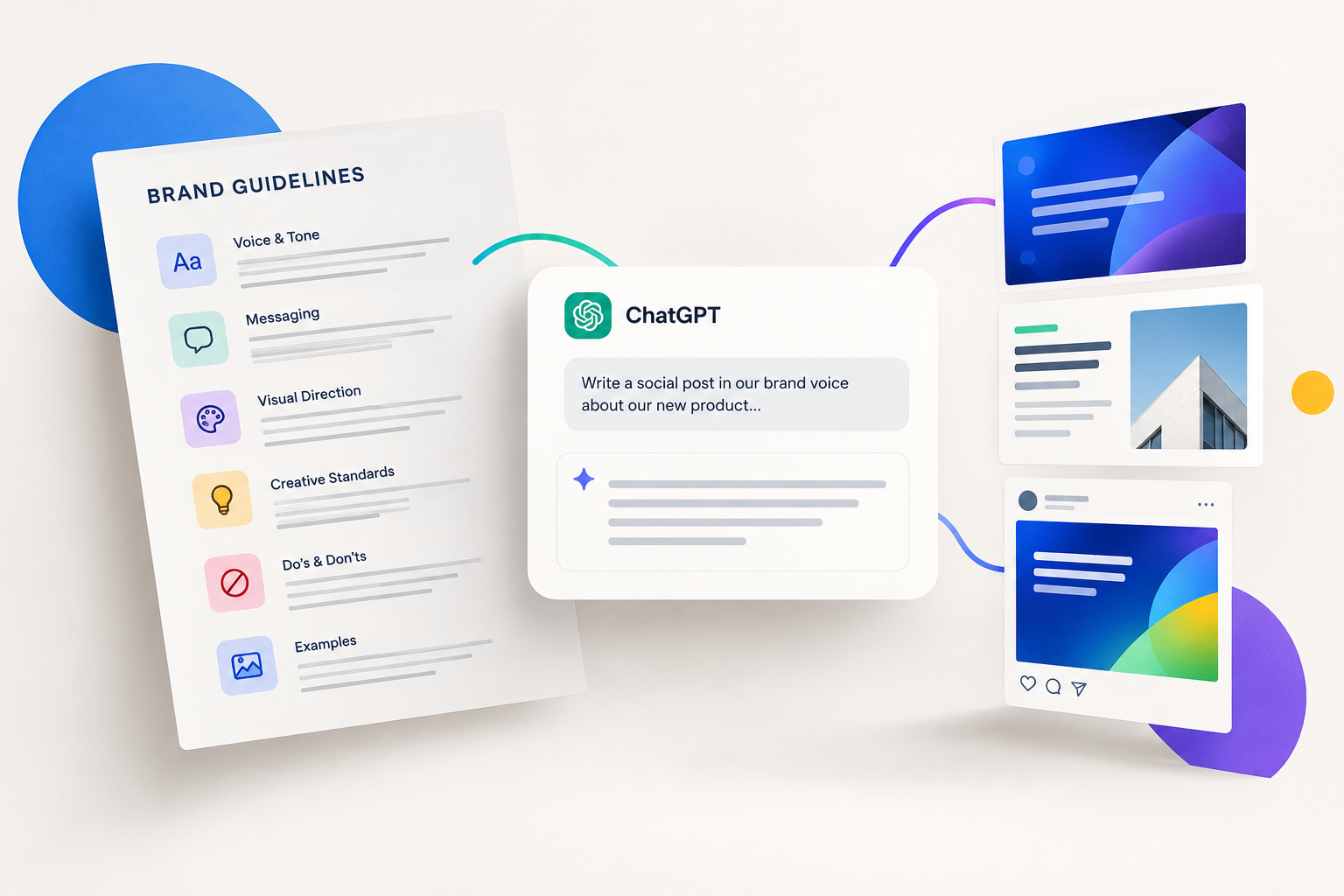
AI makes it incredibly easy to create more content. Keeping all of that content recognizable as yours is the harder part.
AI didn’t create the brand consistency problem.
It just made it much faster.
Before AI, someone could still write an off-brand email, design a questionable ad, or put something into a sales deck that made the creative team wince. But there were natural limits to how much stuff a company could produce.
Now one person can generate 30 headlines, 15 social posts, a landing page, an email campaign and six image concepts before the first meeting of the day.
That’s amazing.
Unless none of it really looks or sounds like you.
And this isn’t a hypothetical problem. Canva recently reported that 94% of the 100+ marketers it surveyed considered brand consistency their top concern as AI content creation scales.
“Technically on-brand” isn’t the same as on-brand
I’ve been doing creative work long enough to know that following the brand guidelines doesn’t automatically make something good.
You can use the correct logo, font and colors and still create something that feels completely wrong.
That's because a brand isn’t a collection of assets.
It’s thousands of decisions.
How big would we make that headline?
Would we actually use that photograph?
Is that too polished?
Too corporate?
Too cute?
Would we ever say that?
Those decisions are obvious to someone who has worked with a brand for years. They’re not obvious to AI.
That’s where the trouble starts.
The problem gets worse when AI gets better
This sounds backwards, but I think it’s true.
Bad AI is easy to catch.
The six-fingered hand is easy to reject. So is the nonsensical copy or the image with your logo mangled into something resembling an alien alphabet.
The more interesting problem is AI work that’s pretty good.
It looks professional. The copy is grammatically correct. The presentation is polished. Nobody can immediately point to what’s wrong with it.
It just could have come from any company.
That’s the stuff I’d worry about.
Because “good enough” can make it through an approval process very easily.
Do that often enough and your brand slowly starts looking like the average of everything AI has seen before.
Your brand guidelines probably weren’t written for this
Most brand guidelines were created to help humans make decisions.
A designer can see “clean, sophisticated and modern” and combine that instruction with years of visual experience.
A copywriter can read “confident but approachable” and interpret it based on the audience, medium and context.
AI has to interpret those same words too, but it doesn't have your team’s accumulated judgment behind them.
That’s why simply uploading the brand PDF isn’t enough.
Traditional brand guidelines are a great starting point, but AI brand guidelines need to capture the decisions, boundaries and context that usually aren’t written down.
This is increasingly the issue other teams working on AI brand consistency are identifying too: static guidelines need to become more operational, with explicit rules, references, constraints and review criteria.
Start documenting the things your team corrects
If I were trying to keep a company’s AI-generated content on-brand, I wouldn’t start by rewriting the brand guidelines.
I’d start with the corrections.
Every time somebody says:
“We wouldn't do that.”
Pay attention.
Why wouldn’t you?
Every time a creative director changes an image, rewrites a headline, removes a word, changes the hierarchy or rejects a concept, there’s probably an unwritten brand rule hiding inside that decision.
Write it down.
Over time, those corrections become something incredibly useful: a record of how your brand actually makes decisions.
That’s far more valuable to AI than another paragraph describing your brand as “innovative.”
Give AI examples of what’s wrong, too
Companies are usually very good at collecting approved work.
Here’s our best campaign. Here’s the website. Here’s the new deck. Here’s the beautiful brand book.
I’d also keep some of the rejects.
Show AI an image that was almost right but too generic.
Show it the headline that sounded clever but wasn’t something your company would ever say.
Show it the email everyone thought was trying too hard.
Then explain why it was rejected.
This is something we naturally do when training people.
We don’t just show a junior designer one perfect layout and say, “There you go.”
We review their work.
We explain what isn’t working.
They learn.
AI needs some version of that context too.
The same principle applies to voice. If you’re training ChatGPT on your brand voice, approved examples and rejected ones can teach it what sounds like you and what doesn’t.
One company shouldn’t have 40 definitions of “on-brand”
There’s another problem I think companies are going to run into very quickly.
Everyone is building their own AI workflow.
The social team has its prompts. The demand-gen person has a custom GPT. Someone in sales uploaded a brand PDF six months ago. The agency has another setup. A new employee is using Claude with instructions they wrote themselves.
Every one of those systems contains a slightly different interpretation of the brand.
That’s not really brand governance.
It's brand telephone.
And as companies use more AI, I think having a shared source of brand truth becomes much more important, not less.
Current approaches to AI brand consistency increasingly center on exactly this idea: one structured source for voice, messaging, terminology, visual direction, constraints and review standards rather than separate ad hoc prompts.
Don’t forget the visuals
Most conversations about keeping AI on-brand immediately become conversations about writing.
But I actually think the visual side could become the bigger problem.
AI can now produce an enormous amount of perfectly attractive creative.
And that’s precisely the danger.
Perfectly attractive isn’t a brand.
If every company asks for "premium," "modern," "minimal," "cinematic" or "bold," we’re going to get a lot of very beautiful work that looks remarkably similar.
Your visual rules need the same treatment as your voice.
What kinds of images would we choose?
What would we never choose?
How much information belongs on a page?
How restrained are we?
What makes something feel too generic?
What does “premium” mean for us?
What visual habits make someone recognize the company before they even see the logo?
Those are brand rules too.
Recent work on AI visual consistency is making the same distinction, emphasizing references, constraints and explicit visual standards rather than relying on descriptive prompts alone.
I don’t want AI making the final brand decision
I don’t think the solution is to automate the creative director out of the process.
Quite the opposite.
AI can generate.
AI can compare.
AI can flag something that violates a known rule.
AI can even explain why it thinks something is off-brand.
But someone still needs taste.
The opportunity is to stop wasting that person's time correcting the same predictable mistakes over and over.
Let AI catch the obvious stuff so humans can spend their time on the decisions that actually require judgment.
The goal isn’t more AI content
This is probably the part I care about most.
The goal isn’t to see how much content we can produce now that AI exists.
Nobody woke up this morning wishing there were more marketing emails in the world.
The advantage is being able to create faster without giving up what made the brand recognizable in the first place.
That’s a very different objective.
That’s the problem BrandSpineX was created to solve.
BrandSpineX takes the knowledge already scattered across your brand guidelines, approved work, messaging, creative standards and people’s heads and turns it into clearer instructions AI can actually use.
Because if AI is going to help create the brand, it needs to understand more than the logo.
It needs to understand the decisions behind it.