
How to Train ChatGPT on Your Brand Voice
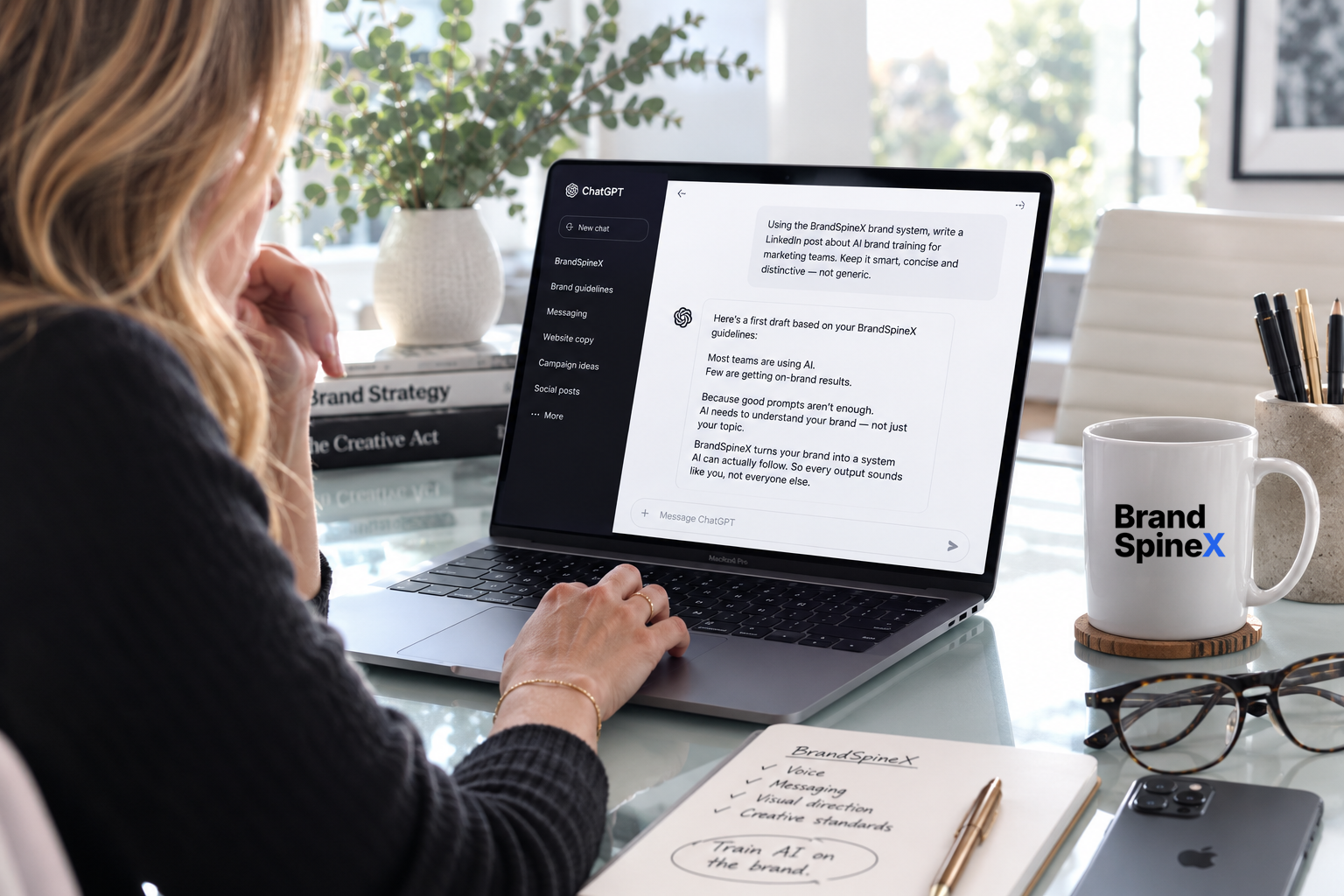
You gave ChatGPT your brand guidelines. It still sounds like ChatGPT.
I keep seeing teams try to solve this by giving AI more adjectives. Be bold. Be human. Be conversational. Be witty, but not too witty.
That’s not really how brands work.
I’ve spent years reviewing creative that technically followed the brand guidelines and was still completely wrong. The logo was right. The colors were right. Nobody broke a rule. And yet everyone in the review could look at it and say, “That’s not us.”
AI has exactly the same problem, except now you can produce 50 versions of “that’s not us” before lunch.
The problem isn’t that ChatGPT can’t write. It's that most companies haven’t taught it how their brand makes decisions.
Your brand voice isn’t three adjectives
Open almost any brand guide and you’ll find some version of this:
Confident. Human. Approachable.
Great. What does “approachable” actually sound like?
Does it mean contractions? Humor? Short sentences? No jargon? Can we swear? Can we make fun of ourselves? Can we start a sentence with “And”? Is “Hey“ okay in an email? What about an enterprise sales deck?
A creative team answers those questions all day without realizing it. ChatGPT can’t.
So if you want to train ChatGPT on your brand voice, stop describing the personality and start documenting the decisions.
Show it what “us” actually looks like
I would start with real work, not a new AI prompt.
Pull together the things that make you think, yes, that‘s us.
A great landing page. Three emails everyone liked. Campaign headlines that survived the review process. A presentation your CEO didn’t rewrite. Social posts that sounded natural. Even rejected work can be useful if you can explain why it was wrong.
Give those examples to ChatGPT and ask it to look for patterns.
Then challenge the answer.
If it tells you the brand is “professional yet approachable,” that’s basically useless. Ask it to get specific. What does the brand do with sentence length? Humor? Claims? Headlines? Jargon? Calls to action? How does it explain something complicated? What does it never do?
Now you’re getting somewhere.
Turn taste into rules
This is the part I think most AI advice misses.
Good creative teams make hundreds of tiny judgment calls that never appear in a brand book.
“This sounds too salesy.”
“We wouldn't say it that way.”
“That's trying too hard.”
“Too corporate.”
“That's technically correct, but it doesn’t feel like us.”
Those comments are annoying when they’re subjective. They're incredibly valuable when you turn them into rules.
Instead of telling ChatGPT:
Be conversational.
Tell it:
Write like a knowledgeable person explaining something to a colleague. Use contractions. Keep the language direct. Avoid corporate filler, exaggerated claims and fake enthusiasm.
Instead of:
Be bold.
Try:
Get to the point quickly. Don’t bury the idea in setup. Use confident statements when the evidence supports them. Prefer specifics over inspirational language.
That’s much harder for AI to misunderstand.
Make a list of everything you hate
This may be my favorite part.
Ask a creative director what the brand is, and you might get a thoughtful ten-minute answer.
Ask what makes them cringe and you’ll have a list in 30 seconds.
That’s useful data.
If your company would never say “unlock,” write that down. If every AI-generated headline seems to contain “reimagine,” ban it. If you hate exclamation points, rhetorical questions, fake enthusiasm, excessive adjectives or sentences that begin with “In today's rapidly evolving...”, tell the AI.
Your brand isn’t defined only by what you choose.
It’s also defined by what you consistently reject.
Voice isn’t enough
This is where I disagree with a lot of the advice about training ChatGPT on a brand. Brand voice is only one part of keeping AI-generated content on-brand. You can teach it to sound like you and still get bad marketing.
Imagine the copy sounds perfect, but it emphasizes the wrong benefit. Or describes the audience incorrectly. Or uses an old product message. Or makes a claim your company would never make.
That’s on-brand writing with off-brand thinking.
ChatGPT needs the hierarchy behind the words too: your positioning, audience, value proposition, differentiators, proof points, terminology and messaging priorities.
And marketing teams aren’t using AI just to write paragraphs anymore. They’re using it for presentations, campaign ideas, landing pages, ads, emails, social posts, creative briefs and images.
So eventually, “brand voice training” becomes something bigger.
You’re teaching AI how the brand thinks.
Don’t make everyone invent their own version of your brand
This is where things can get messy fast.
One person on the team has a giant prompt they’ve been perfecting for six months. Someone else uploads the brand PDF every time. Another person has a custom GPT. Someone new joins the team and types, "Make this more on-brand."
Now you don’t have one AI-trained brand.
You have five interpretations of it.
The better approach is to create one source of truth that captures the voice rules, messaging, examples, visual direction, creative preferences, boundaries and quality standards your team wants AI to follow.
That’s also why traditional brand guidelines aren’t always enough for AI. They were designed to guide people, not necessarily to capture every decision an AI system needs to make.
Then the technology can change without your brand changing with it.
ChatGPT today. Claude tomorrow. Whatever comes six months from now.
The brand logic stays yours.
Here’s the test I would use
Don’t just ask AI to create something.
Ask it to judge something.
Give ChatGPT two pieces of content. One should be unmistakably on-brand. The other should be something your team would reject.
Then ask:
Which one belongs to our brand, and why?
If it gives you vague answers about one being “more engaging” or “more professional,” it doesn't understand the brand yet.
If it can point to your actual voice rules, messaging priorities, creative standards and specific reasons one piece works and the other doesn’t, you’re getting much closer.
Because generating content isn’t the hard part anymore.
Judgment is.
ChatGPT already knows how to write. Teach it who you are.
I don’t think companies need another 40-page brand PDF that sits in a folder somewhere.
They need to translate the judgment already living inside their brand, marketing and creative teams into something AI can actually use.
That’s the idea behind BrandSpineX.
We turn your existing brand materials into clear instructions for voice, messaging, visual direction, creative standards and quality control, so AI has more than a logo and three adjectives to work with.
Because the goal isn’t to make AI sound less like AI.
It’s to make it sound more like you.